Diplomatic Pouch Security: A Free Guide to Safe International Asset and Document Transit
Jump to Section
The diplomatic pouch is the lifeblood of international relations, facilitating the secure transfer of sensitive information, classified documents, and critical assets between a nation's foreign ministry and its overseas missions. While protected by international law, the physical security of these pouches is under constant threat from hostile intelligence services, organized crime, and sophisticated technical surveillance.
In an era of increased global surveillance, relying solely on legal status is insufficient. This guide outlines the professional protocols required to ensure the integrity of diplomatic transit from origin to destination.
The Legal Framework: Vienna Convention
The protection of the diplomatic pouch is enshrined in Article 27 of the Vienna Convention on Diplomatic Relations (1961). Understanding these legal protections is the foundation of pouch security:
- Inviolability: The diplomatic pouch shall not be opened or detained. This is an absolute rule in most jurisdictions.
- Identification: To qualify for protection, the pouch must bear visible external marks of its character.
- Contents: It may contain only diplomatic documents or articles intended for official use.
While the law prohibits host nations from opening the pouch, it does not prevent them from using non-intrusive methods like X-rays or sniffers in some contexts, nor does it stop illicit actors from attempting to intercept or tamper with the contents covertly.
Physical Security and Tamper-Evidence
Physical security is the first line of defense. A pouch must be constructed to withstand the rigors of international travel while providing immediate evidence of unauthorized access.
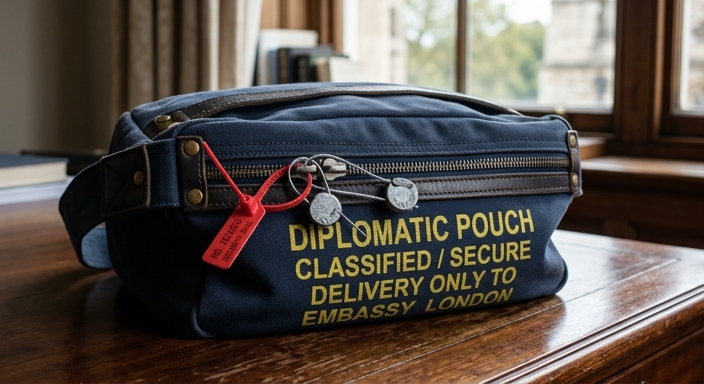
Key physical security requirements include:
- Material Integrity: Pouches should be made of heavy-duty, cut-resistant materials (e.g., Kevlar-reinforced canvas) that cannot be easily slit and repaired.
- One-Time Seals: Use serialized, high-security lead or plastic seals. The serial numbers must be recorded at the point of origin and verified at the destination.
- Electronic Monitoring: Where permitted by policy, internal GPS trackers and light sensors can provide real-time alerts if a pouch is opened or deviates from its route. However, these must be balanced against the risk of the tracking signal being used to locate the courier.
The Role of the Diplomatic Courier
The Diplomatic Courier is the human element of the security chain. Couriers are protected persons under international law, but their primary duty is the "constant surveillance" of the pouch.
Couriers must be trained in Operational Security (OPSEC), ensuring they do not discuss their routes, schedules, or the contents of their shipments. In high-threat environments, "accompanied pouches" are mandatory, meaning the courier never loses line-of-sight of the asset.
Establishing a Chain of Custody
A failure in the chain of custody is where most compromises occur. A rigorous logging system is essential:
- Manifesting: Every item inside the pouch must be logged and verified by a two-person team.
- Seal Verification: At every hand-off (e.g., from Embassy Security to Courier), the seal numbers must be physically inspected and signed for.
- Digital Logging: Use a secure, encrypted database to track the pouch's movement. Avoid using public internet connections to update transit status.
Identifying and Mitigating Common Threats
Security personnel must plan for several specific threat vectors during international transit:
- Technical Surveillance: Advanced X-ray and imaging technology used by host nations to read documents without opening the pouch. Countermeasure: Lead-lined inner bags or Faraday cages for electronic assets.
- Illicit Interdiction: Hostile actors staging "accidents" or baggage delays to gain temporary access to the pouch. Countermeasure: Couriers should never use checked baggage for diplomatic pouches; they must remain in the cabin as carry-on or "seat-loaded" items.
- Clandestine Entry: Skilled technicians opening and resealing a pouch using heat, chemicals, or precision tools. Countermeasure: Utilize multi-layered tamper-evident labels that change color or show "VOID" patterns when tampered with.
Emergency Procedures and Breach Response
What happens if a pouch is detained or damaged? Every mission must have an Incident Response Plan (IRP).
If a host nation customs official attempts to open a pouch, the courier must formally protest, citing the Vienna Convention, and immediately contact the Embassy's Duty Officer. If a pouch is lost or stolen, the classification level of the contents dictates the scale of the security notification, which may include neutralizing compromised cryptographic keys or changing operational plans.
Frequently Asked Questions
Can a diplomatic pouch be X-rayed at an airport?
The Vienna Convention does not explicitly forbid scanning, only "opening or detaining." Many nations now use non-intrusive scanning for aviation safety, though some countries maintain a policy of refusing scans to protect classified information.
What is the maximum size of a diplomatic pouch?
There is no legal limit on the size or weight of a pouch. It can range from a small envelope to a large shipping container, provided it bears the visible diplomatic markings.
Can a diplomatic pouch carry weapons for embassy security?
No. Article 27 specifies the pouch should only contain "diplomatic documents or articles intended for official use." Carrying weapons is generally considered an abuse of diplomatic privilege and can lead to the seizure of the pouch and expulsion of personnel.