I may earn a commission at no extra cost to you. #ad
Emergency Evacuation Planning: A Free Guide for Embassy Security Personnel
Jump to Section
Understanding the Threat Landscape
For diplomatic missions, the necessity for a robust Emergency Evacuation Plan (EEP) is not a matter of "if," but "when." Modern embassy security personnel operate in environments where geopolitical stability can vanish in hours. Whether the catalyst is a sudden coup d'état, an escalating civil war, a massive natural disaster, or a targeted terrorist siege, the objective remains the same: the safe extraction of mission personnel and the protection of state secrets.
Threat assessment must be a continuous process. Security officers must look beyond the immediate perimeter. Intelligence gathering should focus on local infrastructure integrity, host-nation police reliability, and the sentiment of the local populace toward the sending state. A plan that is six months old is often obsolete in a volatile region.
Establishing the Crisis Management Team (CMT)
Success in a crisis depends on a clear hierarchy of command. The Crisis Management Team is the brain of the evacuation operation. At the top sits the Chief of Mission (Ambassador or Chargé d'Affaires), but the tactical execution lies with the Regional Security Officer (RSO) and the security detail.
- The Incident Commander: Usually the RSO, responsible for tactical decisions and movement.
- The Logistics Officer: Manages fuel, vehicles, and food/water supplies for transit.
- The Communications Officer: Maintains links with the home office, other friendly missions, and extraction assets.
- The Medical Officer: Prepares for casualties and manages personnel with chronic health needs.
Every member of the CMT must have a designated deputy. In a high-stress environment, fatigue or injury can quickly sideline key decision-makers; redundancy is the only way to ensure continuity of operations.
The Three Phases of Evacuation
Evacuations rarely happen all at once. Effective planning utilizes a tiered approach to reduce the footprint of the mission as the threat increases.
- Authorized Departure: Family members and non-essential staff are given the option to leave at government expense. This reduces the number of "souls on board" that security must protect.
- Ordered Departure: All non-essential personnel and family members are mandated to leave. The mission moves to a "skeleton crew" focused only on essential diplomatic and security functions.
- Full Evacuation (Suspension of Operations): The mission is closed. All remaining personnel are moved to a safe haven or extracted from the country. This involves the destruction of classified materials and the securing of the physical facility.
Logistics, Routes, and Safe Havens
Transport is the most vulnerable stage of any evacuation. Embassy security personnel must identify multiple extraction methods. Relying solely on the local international airport is a strategic failure, as airports are often the first infrastructure points to be seized or closed during unrest.
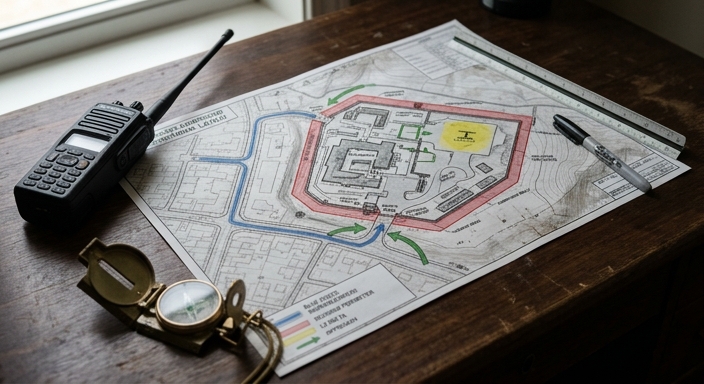
Planners must identify Primary, Alternate, Contingency, and Emergency (PACE) routes to various exit points. These exit points might include military airbases, neighboring land borders, or maritime extraction points. "Safe Havens"—pre-vetted locations like hardened hotels or other friendly diplomatic compounds—should be established as interim rally points if immediate extraction is blocked.
Vehicle fleets must be maintained in a constant state of readiness. This includes armored SUVs with run-flat tires, satellite tracking, and sufficient fuel reserves to reach a border without local refueling.
Communication and Sensitive Asset Destruction
During a crisis, local cellular networks and internet services are frequently throttled or shut down by the host government. Embassy security must maintain independent communication channels. This includes High-Frequency (HF) radio, satellite phones (Iridium or Inmarsat), and secure burst transmitters.
Simultaneously, the "Burn Priority" list must be executed. As an embassy is vacated, sensitive data must not fall into host-nation or rebel hands. Security personnel must oversee the destruction of:
- Cryptographic equipment and keys.
- Classified hard drives (using degaussers or physical shredding).
- Paper files (incineration or industrial cross-cut shredding).
- Biometric data and local staff records.
Personnel Accountability and Drills
The most sophisticated plan will fail if personnel do not know where to go. A "Warden System" should be implemented, where specific staff members are responsible for accounting for a small group of colleagues. In the event of an alarm, these wardens report status directly to the CMT.
Regular "Duck and Cover" or "Rally Point" drills are essential. These should be conducted at varying times of day to account for staff being in different locations. Security personnel should also practice "Blind Fold" drills—moving through the embassy in total darkness or smoke-filled corridors—to prepare for power failures or fire during a tactical withdrawal.