Embassy Perimeter Security: A Free Guide to Blast Mitigation and Physical Barriers
Jump to Section
The Modern Diplomatic Threat Landscape
Embassies and consulates represent the sovereign territory of a nation within a host country. Because of this symbolic and political weight, they are primary targets for a wide range of threats, including Vehicle-Borne Improvised Explosive Devices (VBIEDs), coordinated ground assaults, and civil unrest. Modern perimeter security is no longer just about keeping people out; it is about managing the kinetic energy of an attack before it reaches the "heart" of the mission.
Effective defense requires a "Defense in Depth" strategy. This approach assumes that no single barrier is infallible. Instead, it utilizes multiple layers of security—ranging from psychological deterrents to physical hardening—to delay, detect, and defeat threats. In the current geopolitical climate, the ability to mitigate the effects of a high-yield explosion is the cornerstone of diplomatic facility design.
The Science of Standoff Distance
In the world of blast mitigation, distance is your greatest ally. The physics of an explosion dictates that the pressure of a blast wave decreases significantly as it travels away from the source. This gap between the perimeter and the protected building is known as the "standoff distance."
When designing an embassy perimeter, security engineers calculate the "maximum credible threat" (the largest bomb likely to be used). Based on this weight, a minimum standoff distance is established. If the standoff distance is sufficient, the building's structural integrity can often be preserved using standard reinforced concrete. If space is limited—common in dense urban environments—the building itself must be significantly more hardened to withstand the higher pressure loads.
Physical Barriers: Bollards and Hardened Fences
Physical barriers are the first line of defense against forced entry and vehicle ramming. These are categorized by their ability to stop a specific mass at a specific speed.
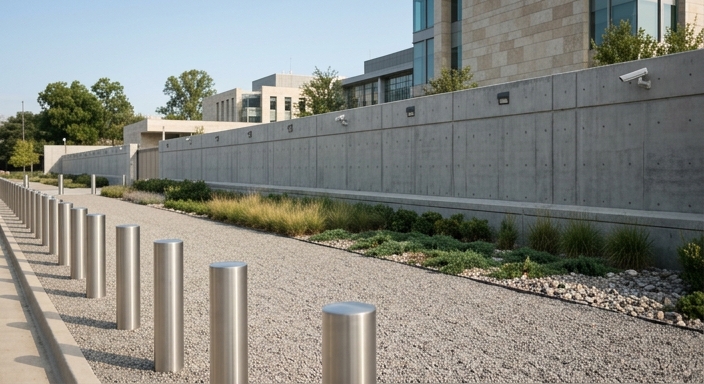
- Anti-Ram Bollards: Typically steel cylinders filled with concrete and anchored deep into a reinforced foundation. The industry standard follows the ASTM F2656 or the older DOS "K-rating" system. A K12-rated bollard is designed to stop a 15,000-pound truck traveling at 50 mph.
- Hardened Fencing: Unlike standard chain-link, embassy fencing often incorporates anti-climb mesh (358 mesh) and internal steel cables that can catch and stop a speeding vehicle.
- Perimeter Walls: Reinforced concrete walls, often disguised with stone veneer, serve as both a visual screen and a kinetic barrier. These must be engineered to prevent "spalling"—where the back of the wall shatters into lethal fragments upon impact or blast.
Structural Blast Mitigation Techniques
When the perimeter is breached or a blast occurs at the line, the building's facade must protect the occupants. This involves specialized engineering focused on three main areas:
1. Blast-Resistant Glazing: Windows are the weakest point of any building. To mitigate this, embassies use laminated glass consisting of layers of glass and polymer (usually PVB). In a blast, the glass may crack, but the polymer interlayer holds the shards in place, preventing them from becoming "glass shrapnel."
2. Progressive Collapse Prevention: The building structure must be designed so that if one column is destroyed by a blast, the rest of the building remains standing. This is achieved through redundant load paths and "strong-floor" designs.
3. Venting and Shielding: Internal layouts are often designed to vent blast pressure away from occupied areas or use "sacrificial" structures like lobbies that absorb energy before it reaches the main offices.
Access Control Points (ACP) Strategy
The Access Control Point (ACP) is the most vulnerable part of the perimeter because it is the only place where the "hardline" must be opened. A modern embassy ACP utilizes a "Sally Port" or "Tiger Trap" design.
In this configuration, a vehicle enters the first gate, which then closes behind it. The vehicle is inspected (often with under-vehicle scanners and explosives detection dogs) while trapped between two sets of K-rated barriers. Only after the vehicle is cleared is the second gate opened. This ensures that even if a vehicle attempts a "ramming follow-through," it is stopped by the secondary barrier system.
Integrating Electronic Surveillance
Physical barriers are "dumb" defenses; they work best when combined with "smart" systems. Electronic security systems (ESS) provide the early warning necessary to activate emergency protocols.
- Video Analytics: Modern CCTV uses AI to detect "loitering" or "abandoned objects" near the perimeter wall, alerting guards before an incident occurs.
- Ground-Based Radar: Used in larger compounds to detect movement in the "buffer zone" between the outer and inner perimeters.
- Seismic Sensors: These can detect tunneling or heavy vehicle movement near the perimeter that might be hidden from visual range.
Frequently Asked Questions
What is the difference between K-rated and M-rated barriers?
K-rating was the original Department of State standard. It has largely been replaced by the ASTM F2656 "M" rating. Both measure the same thing: the barrier's ability to stop a vehicle, but the M-rating provides more granular data on the penetration distance of the vehicle's cargo bed.
Why are embassy walls so high?
Height serves two purposes: preventing "over-the-fence" scaling attacks and providing a visual screen. If an attacker cannot see the inner workings or window locations of an embassy, it is much harder to plan a precision attack.
Can landscaping be used as a security barrier?
Yes. Berms (raised mounds of earth) are excellent at stopping vehicles and absorbing blast energy. Additionally, large planters can house K-rated steel cores while appearing as decorative elements to maintain a friendly diplomatic appearance.